Article content

Denis Kryukov
5 min read
We updated the engine behind Infatica's SERP Scraper so that Google returns poisoned results less often and ad placements are captured more reliably. We also updated how we collect mobile Google results. The update is live by default on the existing /serp endpoint, with no new parameters and no configuration changes.
If you track rankings or monitor ads, the SERP you collect is only useful if it matches what a real user in your target country, on the target device, sees. This update addresses three sources of that mismatch.
Why a posioned SERP doesn't show up as an error
Picture an SEO platform that tracks 3,000 keywords across Germany, France, and the United Kingdom for its clients every day. One morning, a client's product page drops from position 3 to position 11 for a core keyword in Germany. The request succeeded, the HTML parsed, and the report updated on schedule.
But the page the scraper received wasn't the page a user in Germany would see. The client spots the drop first and asks what happened. The platform spends a day finding out that the ranking was never real.
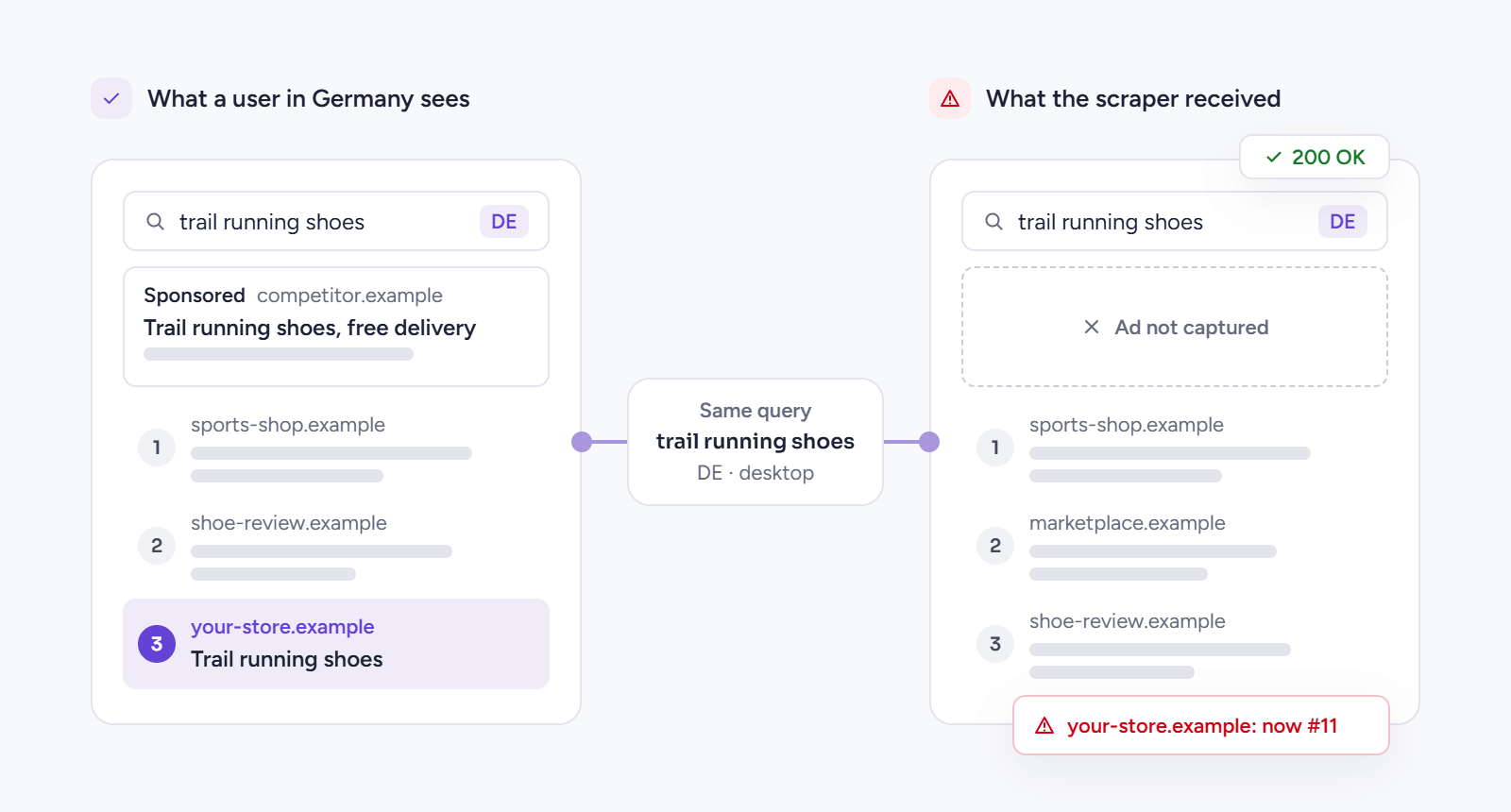
The same page had a second gap. A competitor's ad above the organic results wasn't captured, so that day's share-of-voice report undercounted the competitor.
The first problem is called SERP poisoning. When Google identifies a request as automated, it can respond with results that differ from what a real user would see. The page looks normal and returns no error, so success rate, the metric most scraping pipelines monitor, doesn't catch it. A request can succeed and still be wrong.
What changed in the engine
The update covers three parts of Google SERP collection: how often a request receives a poisoned page, how reliably ads are detected on the page it receives, and how mobile results are collected.
Fewer poisoned results
The new engine reduces how often a request receives a poisoned SERP.
Frequency is what matters at scale. Poisoning doesn't hit every request; it hits a share of them, and that share adds up. Take a rate of one poisoned page per 100 requests: a platform tracking 3,000 keywords would record about 30 wrong positions every day, or roughly 900 a month.
Each wrong position can trigger a false alert, a re-check, or a hard conversation with a client. Teams usually compensate by re-running suspicious queries and checking results by hand, which costs both requests and analyst time. The less often poisoning happens, the less of that verification work lands on your team.
More reliable ad detection
Ads are easy to lose without noticing. If an ad placement isn't recognized during extraction, it's simply absent from the output, and nothing flags the gap.
The new engine detects and extracts ad placements more reliably, so your ad data reflects more of what was actually on the page. For an ad intelligence team, a missed ad is a missing competitor.
Updated mobile collection
Mobile and desktop results for the same query often differ in rankings, layout, and ad formats. If you report mobile visibility, your data has to come from what Google serves to mobile users.
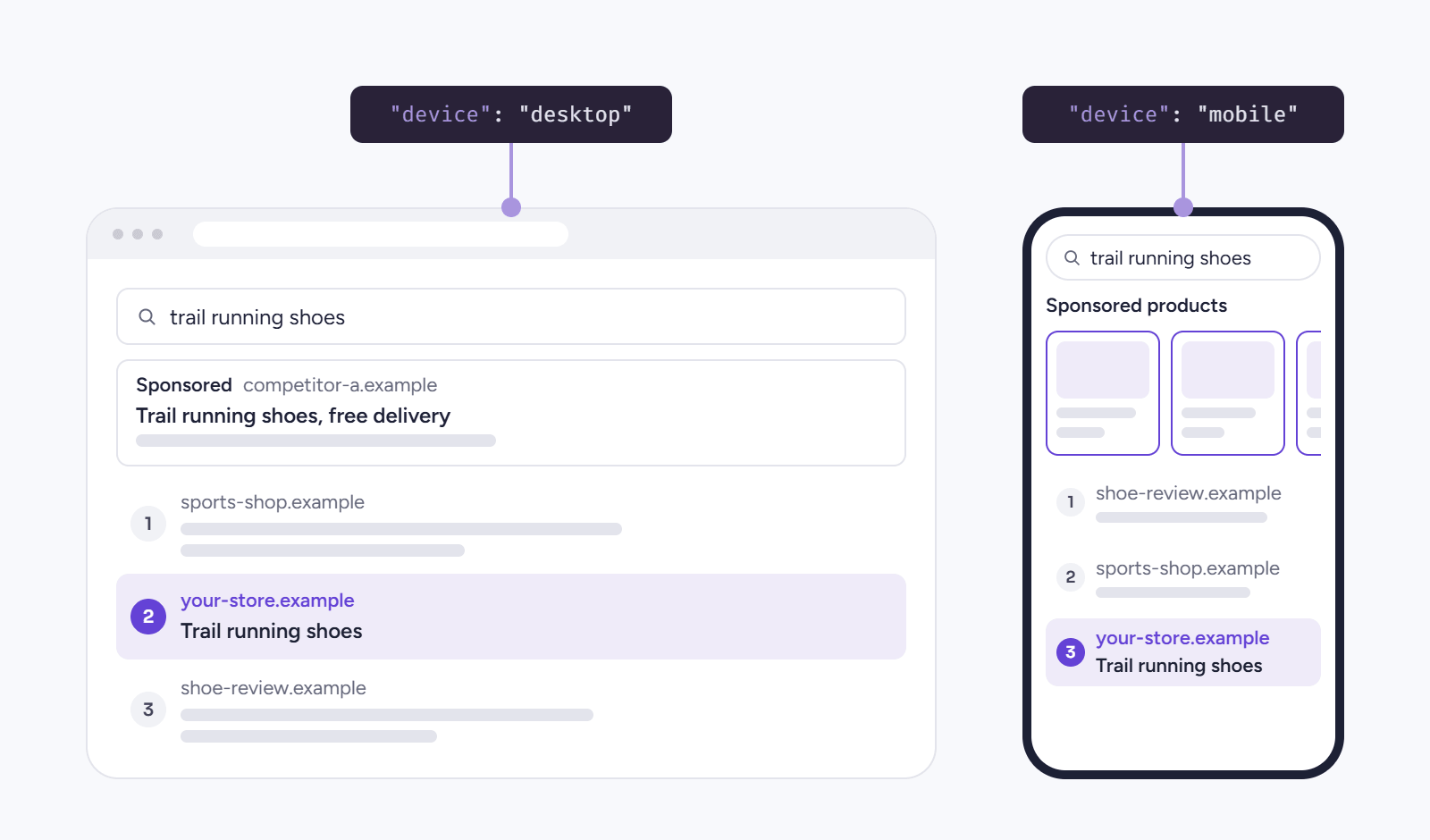
We updated how we collect mobile Google results. When you set device to mobile, the rankings and ad formats you get come from Google's mobile results, not desktop results relabeled as mobile.
Who this update matters for
| Your team | What you collect | What a poisoned or incomplete SERP costs you | What improves |
|---|---|---|---|
| Rank tracking and SEO platforms | Daily positions by keyword and country | Your customers' reports inherit your source data, and a false drop surfaces when a client asks about it | Fewer poisoned SERPs in the data behind position reports, and updated collection for mobile rankings |
| Ad intelligence and competitive monitoring | Which competitors run ads on which queries | A missed ad is a missing competitor, and your coverage claims stop holding up | More reliable detection and extraction of ad placements, on desktop and mobile results |
| Brand protection, price, and market research | Who appears for brand and product queries in each market | Analysis built on a poisoned SERP describes a market your customers never see | Results that more closely match what users in the target country see |
What the SERP Scraper collects
The SERP Scraper returns Google search results through one endpoint, POST https://scrape.infatica.io/serp. With each request, you can:
- Target a country with a two-letter ISO 3166-1 alpha-2 code, and set a language
- Choose the device type: desktop, mobile, or macOS
- Request up to 100 results across up to 10 pages, or select specific pages
- Receive raw HTML or parsed JSON
- Switch to browser rendering, which also enables collection of Google AI Overviews when Google returns one
If a plain request fails, retry handling can switch it to rendering automatically. In scrape mode, each SERP page counts as one request. See the SERP Scraper page and the API documentation for the full parameter list.
Do I need to change anything?
No. The new engine is already running on /serp, with the same endpoint and the same parameters. There's no version to pin and no flag to turn on.
A request like this one, collecting 30 results for a query in Germany, works exactly as it did before the update:
curl -X POST "https://scrape.infatica.io/serp" \
  -H "X-API-Key: YOUR_API_KEY" \
  -H "Content-Type: application/json" \
  -d '{
    "url": "https://www.google.com/search?q=restaurants",
    "country": "DE",
    "results": 30
  }'
The difference is in what comes back: fewer poisoned pages and more complete ad data.
Frequently asked questions
No. It reduces how often a request receives a poisoned SERP. Google's handling of automated traffic keeps changing, so no provider can guarantee clean results on every request. We continue to work on it.
Google. The
/serp endpoint applies to Google search URLs.
No. The endpoint, parameters, and response formats stay the same, and the new engine is on by default.
No. Billing works as before: in scrape mode, each SERP page counts as one request.
Yes. Set the
device parameter to mobile; the default is desktop. This update also changed how mobile results are collected, so mobile rankings and ad formats come from Google's mobile results.