Article content

Jan Wiśniewski
6 min read
Modern applications generate more traffic, handle more users, and rely on more distributed systems than ever before – putting increasing pressure on the underlying databases. To keep performance predictable and operations scalable, many engineering teams rely on database proxies. Let's explore what database proxies are, how they work, the problems they solve, and how they fit into the broader ecosystem of tools that help organizations manage both internal and external data flows!
What Is a Database Proxy?
A database proxy is an intermediary layer that sits between your application and its database. Instead of your app connecting directly to the database server, it connects to the proxy, which then manages how queries and connections are routed on its behalf. This extra layer helps optimize performance, improve reliability, enforce security policies, and simplify scaling as your application grows.
At its core, a database proxy handles three main tasks. Connection management: It maintains a pool of persistent database connections and allocates them efficiently to incoming application requests. This prevents the database from being overwhelmed by too many short-lived connections.
Intelligent routing: Queries can be directed to different database instances – such as directing reads to replicas and writes to the primary node. This helps distribute load and reduces pressure on a single server.
Centralized control and security: The proxy can enforce authentication, IP allowlists, traffic rules, query limits, or encryption standards. This gives teams a single, consistent place to manage access instead of configuring every application separately.

Conceptually, we can imagine the proxy as a smart traffic controller: It understands which queries are coming in, where they should go, and how to maintain stable, high-performance communication between your application layers and the underlying database infrastructure.
Core Use Cases of Database Proxies
While small systems may run fine with direct database connections, growing workloads, distributed architectures, and global user bases quickly expose bottlenecks that a proxy can address.
Connection Pooling for High-Traffic Applications
Opening and closing database connections is expensive. Each new connection consumes CPU, memory, and I/O on the database server. A proxy maintains a pool of persistent, ready-to-use connections and allocates them as requests arrive.
Result: Lower overhead, faster response times, and more stable performance during traffic spikes.
Load Balancing Across Replicas
Modern databases often run with multiple replicas – one primary for writes and several read-only replicas. A proxy intelligently distributes read queries across these replicas, ensuring that no single node becomes a bottleneck.
Result: Better resource utilization and horizontal read scaling.
Choosing Between a Load Balancer and a Reverse Proxy
Not sure whether to deploy a load balancer, reverse proxy, or both? This guide breaks down each component, their roles in modern infrastructure, and where proxies fit in.
 Jovana Gojkovic
Read/Write Splitting
Many applications mix high-volume read operations with critical write operations. A database proxy can automatically route:
- Write queries → Primary node
- Read queries → Replica nodes
Result: Higher throughput and reduced load on the primary database instance.
High Availability and Failover Management
If a database node becomes unavailable, the proxy can automatically detect the failure and reroute traffic to healthy instances.
Result: Minimal downtime and simpler failover logic – without requiring application-level changes.
Query Routing and Traffic Shaping
Some proxies support advanced routing rules based on:
- Query type
- Schema or table
- User identity
- Source application
- Time of day or load patterns
Result: Fine-grained control that helps isolate workloads, enforce policies, or route specific queries to dedicated infrastructure.
Enhanced Security and Access Control
By acting as a gatekeeper to the database, the proxy can enforce:
- Authentication and authorization
- IP allowlists
- TLS/SSL encryption
- Rate limits
- Auditing and logging
- Query filtering or throttling
Result: A consistent security layer that protects the database even if multiple services or teams access it.
Types of Database Proxies
| Proxy Type | Description | Typical Use Cases | Pros | Cons | Examples |
|---|---|---|---|---|---|
| SQL Database Proxies | Purpose-built proxies for relational databases such as MySQL, PostgreSQL, and MariaDB. | High-traffic relational workloads, read/write splitting, connection pooling. | Mature tooling, strong community support, advanced routing rules. | Limited to SQL databases; may require tuning. | PgBouncer, Pgpool-II, ProxySQL, MaxScale |
| NoSQL Database Proxies | Intermediaries designed for distributed NoSQL systems. | Large-scale, schema-flexible applications; caching; replication-aware routing. | Improve consistency, handle distributed nodes, simplify client logic. | Support varies widely by NoSQL engine. | Dynomite, Envoy integrations, custom proxy layers |
| Language-Level Proxies (ORM/Driver-Based) | Proxies embedded in libraries or ORMs that emulate proxy behavior client-side. | Small to mid-sized apps, simple pooling, basic retry logic. | Easy to implement, no separate service required. | Limited features; no centralized management. | HikariCP, SQLAlchemy Engine Pool, Sequelize Pool |
| Cloud-Managed Proxies | Fully managed proxy layers offered by cloud providers. | Cloud-native apps requiring HA, IAM integration, and automatic scaling. | No maintenance, tight integration with cloud IAM and monitoring. | Cloud lock-in; limited configurability. | AWS RDS Proxy, GCP Cloud SQL Auth Proxy, Azure DB Proxy |
Key Features to Look for in a Database Proxy
Not all database proxies offer the same capabilities. When selecting one for your infrastructure, it’s important to understand which features will meaningfully improve performance, simplify operations, and support long-term scalability.
Intelligent Load Balancing
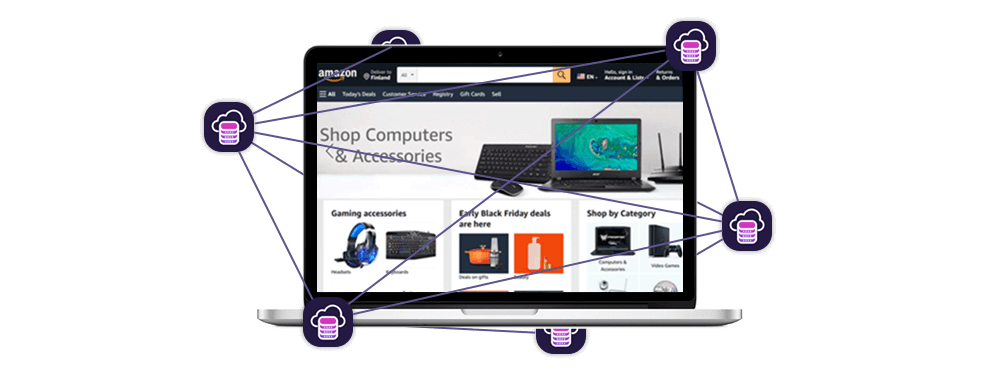
A good proxy distributes queries using load-aware algorithms – round-robin, least connections, latency-based routing, or replica health metrics – to prevent bottlenecks and ensure predictable performance.
Automated Failover and High Availability
Failover support allows the proxy to detect failed nodes and reroute traffic without manual intervention. This keeps applications running smoothly during outages or maintenance windows.
Compatibility and Deployment Flexibility
Proxies vary in how they integrate with cloud environments, containers, Kubernetes, or multi-region architectures. Ensure the proxy supports:
- Your database engine and version
- Your deployment model (VMs, containers, serverless)
- Seamless scaling and configuration management
Support for Static IPs and Access Policies
Some applications require stable source IPs for allowlists, compliance, or partner integrations. A proxy that supports fixed outbound IPs simplifies security management – especially when dealing with multi-service environments. This also highlights a key distinction: database proxies help manage internal traffic, while network-level proxies fill the same role for external data acquisition and public-web traffic.
Power Your External Data Workflows with Reliable Proxy Infrastructure
While database proxies optimize internal data access, many modern platforms also rely on external data – price monitoring, market intelligence, competitor research, and more. For these workflows, you need stable, compliant, and scalable access to the public web.
Infatica provides proxy solutions designed for high-volume data collection, geotargeting, and reliable API access.
Frequently Asked Questions
A database proxy is an intermediary layer between applications and a database. It manages connections, balances traffic, enforces security rules, and improves scalability by routing queries intelligently and reducing load on the underlying database servers.
A database proxy is useful when your application experiences high traffic, uses multiple replicas, requires predictable performance, or needs centralized access control. It becomes essential in microservices architectures and systems demanding high availability and efficient connection management.
It maintains persistent connection pools, distributes queries across replicas, and routes reads and writes appropriately. These mechanisms reduce overhead, prevent connection storms, and help databases handle larger workloads without degrading response times.
Most modern proxies are straightforward to deploy and integrate with containerized, cloud, or on-prem environments. However, they require configuration tuning – such as setting pool limits and routing rules – to perform optimally under real production workloads.
A load balancer distributes incoming traffic but lacks database-specific logic. A database proxy understands query types, read/write behavior, and connection management. It routes database requests intelligently, making it more suitable for database workloads than generic load balancers.